
AI: A World Without Thinking Creates a Different Kind of Human
Series: This is part 3 of a 3 part series, and my personal favorite. Please also consider reading Let Creatives be Creative and CAN We Fill the Generation Gap?
If you think the internet shook up the world as we knew it, just wait.
What we experienced in the shift from analog to digital was the warm-up act. Artificial intelligence is the main event. And the crowd has no idea what is about to happen. How can we? We are not viewing this from a pre- or post-AI moment, or even from a safe distance. We are watching it unfold in real time, almost in slow motion, as we hold our collective breath.
No intermission. No program. Just the lights going out.
The internet changed how we access information. AI is changing who does the thinking. That distinction matters.
We excitedly or begrudgingly adapted to the internet as a tool. AI is quietly positioning itself as a proxy, not just for labor, but for judgment, memory, creativity, and decision-making. And unlike the internet, this shift is happening so fast there is no clean “before” and “after.” There is only now.
The internet answered questions. AI answers for you.
Gen X and Millennials learned by exploring options, asking questions of people who knew more than we did, and sometimes getting it wrong before getting it right. We asked, tried, failed, and got back up to repeat the process. Even Google required effort, though minimal. You still had to figure out what to ask, decide what information mattered, what was credible, and what applied.
Artificial intelligence removes most of that work.
It summarizes. It chooses. It predicts. It writes. It finishes your sentence before you realize you were still forming the thought.
Struggle used to be part of how we learned. If AI removes the process, how much are we really learning?
Learning used to require effort. Now it often requires approval.
Gen Alpha and the generations that follow will never know a world without AI. Just as Gen Z never knew life without the internet, these kids will never know life without an AI-augmented reality that can think faster, recall more, and respond instantly. How will they learn to think for themselves? How will they learn to learn?
They will not know the struggle of research. They will not need to ask parents or friends how to do something unfamiliar.
They will not have to sit with confusion long enough to even identify what they are confused about.
They will not learn how to think, at least not in the same way generations before them did.
Why not? Because the answer will always be right there, waiting, before they even ask the question.
A world without the need to think creates a different kind of human.
Before the internet, jobs were often physical or labor-intensive, well-defined, and location-based. After the internet, entire digital careers emerged that our parents never imagined. Boomers and Gen X adapted. The generation that followed grew up fluent.
AI is about to do that again, only faster and with far fewer guardrails. And this time, we do not even agree on where the rails should be.
Jobs That Existed Before AI
Research Assistant
Junior Copywriter
Entry-Level Designer
Data Analyst
Customer Support Representative
Proofreader
Translator
Scheduling Assistant
Market Researcher
Paralegal Support Roles
Many of these roles were not glamorous, but they mattered. They were where people learned how to think, evaluate, and grow.
AI does not just replace jobs. It blew up the on-ramp.
Jobs That Exist Because of AI
AI Prompt Engineer
AI Ethicist
Automation Strategist
Model Trainer
AI Operations Manager
Synthetic Data Specialist
Human-in-the-Loop Reviewer
AI Content Evaluator
Workflow Architect
These roles require judgment, not repetition. Strategy, not task execution. The problem is that judgment used to be learned through the very jobs AI is now absorbing.
AI has exploded the middle of the ladder. This is where the next gap forms.
Those who learned to think before AI will use it as leverage. Those who grow up with AI may never realize which mental muscles they did not have to build. Not because they are incapable, but because the environment they knew from birth never required it.
Capability follows expectation. And we quietly lowered the bar without meaning to.
We already saw this once with the internet. Skills faded. Attention shifted. AI will amplify these changes, and not in a good way. Writing. Reasoning. Problem-solving. Math. Even creativity will feel different when the first draft never comes from you.
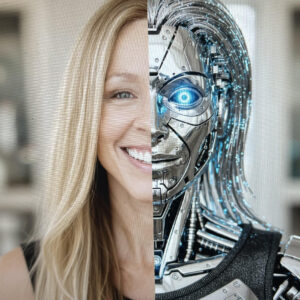
When tools think for us, we risk forgetting when and why we stopped thinking.
The danger is not in using AI. It is never noticing when we no longer struggle, pause to think, or ask questions at all.
This is not a warning. It is a reckoning.
Even if we wanted to, and many do not, we cannot stop AI any more than we stopped the internet. But we can decide how it is modeled, taught, and integrated. We can teach kids how to think with it instead of letting it think for them.
The danger is not AI. It is disengagement.
This Conversation Didn’t Start Here
This question didn’t begin with AI. In Can We Fill the Generational Gap?, I explored why gaps form between generations in the first place and how much of that divide is shaped by environment, experience, and what we choose to model instead of mock.
More recently, in Letting Creatives Be Creative, I examined what happens when systems optimize for speed and efficiency at the expense of thinking, experimentation, and human judgment, a tension AI is now accelerating across every field.
This piece sits between those two conversations. It’s the moment where the gap becomes impossible to ignore.
This gap is coming. We can already see it forming.
The question is not whether AI will change how we think.
It is whether we stay passive while it does or do something about it.
In the next piece, I will explore how we can actually bridge this gap, not with fear or nostalgia, but by protecting the act of thinking itself.