
A Practical Guide to Answer Engine Optimization (AEO)
How to Make AI Actually Recommend Your Business
You can rank beautifully in Google and still be invisible where decisions now happen. That statement used to sound dramatic. Today it is simply accurate.
Traditional SEO still matters. But search has quietly shifted from lists of links to direct answers, and those answers increasingly come from AI systems that decide which sources are worth quoting. If your content is not written, structured, and validated in a way answer engines can understand and trust, it does not matter how strong your keyword strategy is. You are not in the conversation.
Answer Engine Optimization is how you change that.
What Is Answer Engine Optimization (AEO)?
At its simplest, Answer Engine Optimization is about one thing: when Google or another search engine shows an answer box at the top of the results, you want that answer to come from your website.
You have already seen this in action. You search a question and instead of a list of links, Google displays a direct answer pulled from a single source it trusts. That source becomes the expert. Everyone else becomes optional.
Answer Engine Optimization is the practice of shaping your content so search engines and AI-powered systems choose you as that trusted source.
More formally, AEO means optimizing content so systems like ChatGPT, Google AI Overviews, Perplexity, Claude, and Bing Chat directly cite and recommend your content when answering user questions. These systems do not scan the entire web equally. They pull from a short list of sources that are clear, authoritative, well-structured, and context-rich.
This is not about ranking first. It is about becoming the answer itself.
When a user asks a question and an AI-generated response appears, that response is assembled from a small group of trusted experts. If your content is written in a way that is easy to extract, easy to verify, and hard to misunderstand, you can be included. If it is not, the system will confidently answer the question using someone else’s work.
That is AEO in practice.
SEO vs Answer Engine Optimization
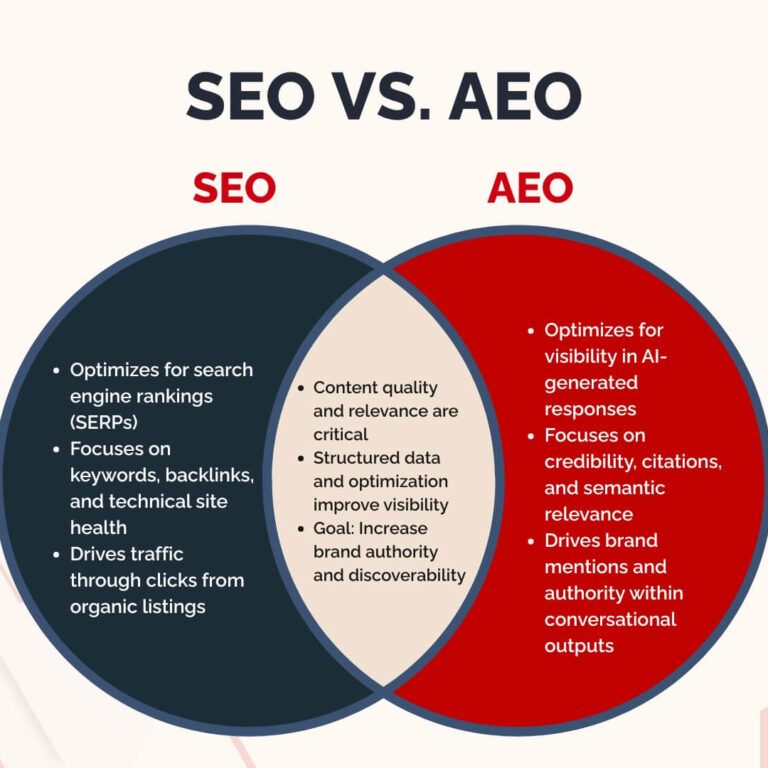
What is the difference between SEO and AEO?
SEO focuses on getting users to click through to your site.
AEO focuses on getting your content quoted, summarized, or referenced directly inside the answer itself.
In traditional search, users scan links and decide where to click. In AI-powered search, the decision is often made for them. The AI presents a synthesized answer and cites the sources it trusts most.
Those sources become the recommendation layer. Everyone else disappears.
If your content is not designed to be extracted, understood, and trusted by an answer engine, it will not surface, no matter how polished it is.
Why Answer Engine Optimization Matters in 2026
Why is AEO no longer optional?
Because user behavior has already changed:
- ChatGPT reached roughly 800 million weekly active users by January 2026.
- Perplexity processed hundreds of millions of queries in a single month.
- Google AI Overviews now appear in the majority of search results.
- Nearly two thirds of consumers report using generative AI as part of how they search.
The real shift is not adoption. It is completion.
People are increasingly getting answers without clicking anything. They ask a question, receive a synthesized response, and move on. That means visibility is no longer tied only to traffic. It is tied to whether your content becomes part of the answer layer.
How Search Behavior Has Changed
How does AI-powered search differ from traditional search behavior?
- Traditional search involves browsing, comparison, and multiple clicks before a decision is made.
- AI-powered search delivers a complete answer with context, explanation, and recommendations, often with little or no follow-up clicking.
- If your content does not appear inside that answer, you are not influencing the decision, even if your SEO performance looks strong on paper.
How Is Answer Engine Optimization Different From Traditional SEO?
What does AEO prioritize that SEO does not?
Traditional SEO focuses on keywords, backlinks, metadata, crawlability, and driving clicks.
Answer Engine Optimization prioritizes clarity, structure, authority, and context. It rewards content that answers specific questions directly, uses natural language, demonstrates expertise, and can be confidently quoted.
Both approaches value quality, user intent and trust. The difference is the goal.
SEO’s goal is to earn the click.
AEO’s goal is to earn the citation / provide the answer.
The Answer Engine Optimization Playbook
How do you actually optimize content for answer engines?
AI models are trained on human language patterns, not keyword lists. Content that reads like a clear explanation from a knowledgeable professional consistently outperforms content written to satisfy algorithmic checklists.
Keyword-stuffed copy fails because it lacks coherence and intent. Conversational, precise language works because it mirrors how people actually ask and answer questions.
When content sounds like a smart human explaining something to another smart human, it becomes extractable.
How Should Content Be Structured for Answer Engines?
Answer engines rely heavily on structure. Question-based headers reduce ambiguity and make extraction easier. When your H2 and H3 tags mirror the questions users ask, you remove friction for both humans and machines.
Examples include:
- What is Answer Engine Optimization?
- How does AEO differ from SEO?
- When should businesses focus on AEO?
- Why is AEO important now?
How Should Answers Be Presented for AI Extraction?
- Answer engines favor content that answers the question immediately and then expands.
- Lead with the answer. Follow with explanation, nuance, and examples.
- The opening sentence is what gets quoted. The rest is what builds trust.
What Role Does Structured Data Play in AEO?
Schema markup provides explicit context that helps AI systems interpret your content correctly.
- FAQ schema
- How-To schema
- Article schema
- Product schema
- Review schema
- Local Business schema
Schema is not about rankings. It is about comprehension.
How Do Answer Engines Evaluate Authority?
What signals tell AI that your content is trustworthy?
- Clear author attribution and bios
- Visible credentials and experience
- Citations from credible sources
- Consistent topical coverage
- Mentions from other authoritative sites
- Answer engines increasingly cross-check sources. Content that contradicts established knowledge without strong evidence is filtered out.
- Authority is demonstrated, not implied.
How Do Featured Snippets Connect to AEO?
Why do featured snippets matter?
Because content formatted to win featured snippets is already optimized for extraction. Answer engines often reuse that structure when generating responses.
- Answer the question within the first 40 to 60 words.
- Use clear formatting.
- Be specific and factual.
- Match the question in your header.
Why Original Data Matters for Answer Engine Optimization
Answer engines strongly favor original research.
If you publish data that does not exist elsewhere, the AI has no alternative source. That makes your content inherently cite-worthy.
- Original studies
- Proprietary datasets
- Expert interviews
- First-hand case studies
- Industry research
How Comprehensive Should AEO Content Be?
Shallow content does not perform well in answer engines.
Strong AEO content answers the main question, anticipates follow-up questions, provides context, includes examples, and acknowledges nuance. Depth signals confidence. Thin content signals risk.
Why Content Freshness Still Matters
Answer engines prioritize current information, especially in fast-changing industries.
Visible publication dates, update timestamps, and regular maintenance matter. Stale content loses trust.
Why Structure Matters More Than Ever
Tables, lists, and clearly segmented sections make information easier to extract. When content is well organized, answer engines do not have to guess what matters.
What Smart Brands Are Doing Now
What does effective AEO adoption look like in practice?
Forward-thinking brands are rewriting content to sound like expert conversations instead of SEO exercises. They are building connected ecosystems across text, video, audio, and visuals so context is reinforced everywhere.
They are investing in original research because it creates citation gravity. They are implementing schema consistently instead of treating it as an afterthought. And they are building real expertise instead of manufacturing authority.
Your Answer Engine Optimization Action Plan
What should you do first?
Week 1 focuses on auditing. Test your core topics inside ChatGPT, Claude, and Perplexity. Identify where you are cited and where you are not. Review schema coverage and identify question gaps.
Weeks 2 and 3 focus on quick wins. Add FAQ sections. Rewrite introductions to answer questions immediately. Convert headers to question format. Strengthen author bios and credentials.
Months 1 and 2 focus on structural changes. Implement schema across priority pages. Create at least one piece of original research. Rewrite high-value content using AEO principles. Build comprehensive pillar pages.
Month 3 and beyond focuses on compounding advantage. Refresh content regularly. Add structured tables and summaries. Track which platforms cite you and optimize accordingly.
Common Answer Engine Optimization Mistakes
What causes content to fail in AEO?
- Writing for machines instead of humans
- Keyword stuffing
- Ignoring E.E.A.T. best practices
- Failing to cite credible sources
- Publishing thin content
- Neglecting technical health
Answer engines are trained to recognize clarity, credibility, and coherence. Shortcuts are easy to detect.
How to Measure Answer Engine Optimization Success
What metrics matter for AEO?
- Citation frequency across platforms
- Brand mentions inside AI-generated answers
- Quality and prominence of citations
- Featured snippet acquisition
- Referral traffic from AI platforms
Track patterns monthly. AEO compounds slowly at first, then accelerates.
The Bottom Line on Answer Engine Optimization
Answer Engine Optimization is not replacing SEO. It is extending it.
As AI becomes the default interface for search, content that cannot be quoted will struggle to stay visible. The brands that win will create genuinely useful, authoritative content structured for both humans and machines.
In a few years, this will not be called AEO. It will simply be how content works. Quality still wins. Structure determines whether it gets seen.
What Happens If You Wait
Your competitors are already adapting.
Some are rewriting content. Some are publishing research. Some are quietly building citation momentum that becomes harder to displace over time.
Six months from now, their brands will appear in AI answers. Yours may not.
Twelve months from now, traffic declines will feel confusing because rankings still look fine, but the answer already happened before the click.
This is not hype. It is math.
You can start optimizing now and build authority while the field is still open, or you can wait and try to catch up after citation patterns are established.
The next decade of search is being shaped right now.
For a fun, simpler version of this piece, please visit the What is AEO piece I originally wrote.
Further Reading & Educational Resources.
Was this helpful? Please let me know.
References at the Bottom
References
- DemandSage (2026). “ChatGPT Users Statistics (January 2026) – Growth & Usage Data.” Retrieved from https://www.demandsage.com/chatgpt-statistics/
- Used for: ChatGPT user statistics (800 million weekly active users)
- Index.dev (2025). “Perplexity AI Features and Statistics 2025.” Retrieved from https://www.index.dev/blog/perplexity-statistics
- Used for: Perplexity query volume (780 million queries in May 2025)
- DemandSage (2026). “50 AI Overviews Statistics 2026.” Retrieved from https://www.demandsage.com/ai-overviews-statistics/
- Used for: AI Overviews impact on organic traffic and citation sources
- Semrush (2025). “Semrush AI Overviews Study: What 2025 SEO Data Tells Us About Google’s Search Shift.” Retrieved from https://www.semrush.com/blog/semrush-ai-overviews-study/
- Used for: AI Overviews prevalence in search results
- Junhammer (2025). “8 Eye-Opening Statistics: Why Answer Engine Optimization Matters in 2025.” Retrieved from https://junhammer.com/blog/8-statistics-that-prove-why-answer-engine-optimization-is-crucial-in-2025/
- Used for: AEO strategy effectiveness and traffic impact
- Amsive (2025). “Answer Engine Optimization (AEO): Your Complete Guide to AI Search Visibility.” Retrieved from https://www.amsive.com/insights/seo/answer-engine-optimization-aeo-evolving-your-seo-strategy-in-the-age-of-ai-search/
- Used for: Consumer adoption rates of generative AI for search
- BrightEdge (2025). “One Year Into Google AI Overviews, BrightEdge Data Reveals Google Search Usage Increases by 49%.” Retrieved from https://www.brightedge.com/news/press-releases/one-year-google-ai-overviews-brightedge-data-reveals-google-search-usage
- Used for: Impact of AI Overviews on impressions and click-through rates
- WordStream (2025). “34 AI Overviews Stats & Facts [2025].” Retrieved from https://www.wordstream.com/blog/google-ai-overviews-statistics
- Used for: User engagement with AI Overview content
- Nine Peaks Media (2025). “Emerging Trends in AEO for 2025: What’s Next for Answer Engine Optimization?” Retrieved from https://ninepeaks.io/emerging-trends-in-aeo
- Used for: Marketing priorities and future traffic predictions
- Surfer SEO (2025). “What is Answer Engine Optimization? 7 AEO Strategies for 2025.” Retrieved from https://surferseo.com/blog/answer-engine-optimization/
- Used for: Generative AI adoption rates by demographics