
What is AEO?
A Practical Guide to AEO (Answer Engine Optimization)
How to Make AI Actually Recommend Your Stuff
Note: This is the “fun” version that I originally wrote. I rewrote it – just to do it – in a more polished and professional tone if you’d like to read that version instead.
So, you’ve mastered SEO, you’re crushing it with keywords, and your website is ranking beautifully on Google. So you’re solid, right? Uh, not for long. The game is changing, and if you’re not thinking about AEO yet, you’re about to get left behind.
What on Earth is AEO?
Answer Engine Optimization (AEO) is optimizing your content so AI-powered tools (think ChatGPT, Google’s AI Overviews (formerly SGE), Perplexity, Claude, Bing Chat, and other AI assistants) actually cite and reference your content when answering questions.
Here’s the key difference:
SEO = Getting your link to show up in search results
AEO = Getting your actual content featured in AI’s answer
Think about this: when someone asks an AI “What’s the best CRM for small businesses?” AI doesn’t just give them a list of links anymore. Now, it gives them a detailed answer, maybe mentions 3-5 specific tools, explains why, and might cite where it got that information. If your content is well-optimized for AEO, you’re hopefully the one cited in the answer. If not? You’re invisible.
Why AEO Matters RIGHT NOW
Let’s look at some numbers that should wake you up:
- Over 1 billion people have tried ChatGPT (as of 2024)
- Google is rolling out AI Overviews to billions of searches
- Perplexity is handling millions of queries daily
- 43% of marketers say generative AI is already changing their SEO strategy (that number’s only going up)
The Shift is Real
How Traditional search used to look:
“trendy women’s combat boots” → Click through 5 websites → Make decision
How AI-powered search looks:
“What are the trendiest combat boots for women under $150?” → Get comprehensive answer with recommendations → Maybe click one link to buy
See the difference? AI is hogging the keys to the gate. If you’re not optimizing for these answer engines, you’re losing visibility even if your traditional SEO is perfect.
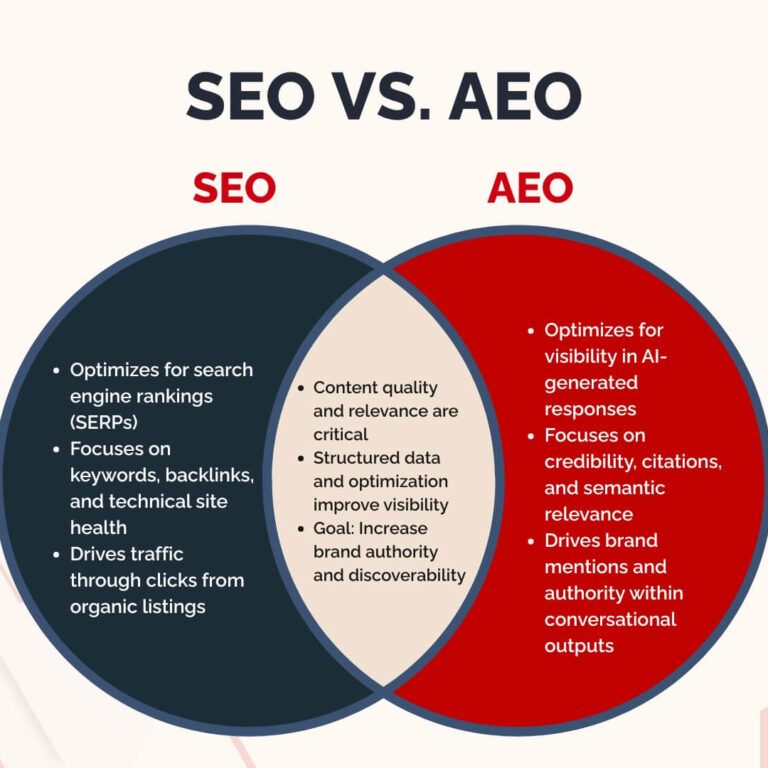
How AEO is Different from SEO
Let me break this down because it’s crucial:
SEO Focuses On:
- Keywords and keyword density
- Backlinks
- Meta titles and descriptions
- Page speed and technical optimization
- Getting clicks to your site
AEO Focuses On:
- Direct, clear answers to specific questions
- Structured data and context
- Authority and credibility signals
- Human/natural sounding language and conversational content
- Being quotable and cite-worthy
- Entity recognition (people, places, things AI can identify)
Both Care About:
- Quality content
- User intent
- E.E.A.T. (Experience, Expertise, Authoritativeness, Trustworthiness)
- Mobile optimization
- Fresh, updated content
With SEO you’re chasing clicks. With AEO, you’re earning citations.
The AEO Optimization Playbook
Enough theory. Here’s how you actually do this:
1. Write Like You’re Answering a Smart Friend’s Question
AI models are trained on natural, human language. If your content sounds like keyword-stuffed robot speak, you’re doing it wrong.
Bad (SEO-speak): “Best coffee shops top rated 2026 near me delivery”
Good (AEO-friendly): “The best coffee in Houston, Texas depends on what style you prefer. For classic black roast, Holly’s Java in Meyerland has been serving steamy, bold perfection since 1974. If you want a caramel macchiato, Roberta’s in Friendswood uses imported organic South American coffee beans and organic caramel with a dab of whipped cream on top.”
See the difference? AI’s answer was natural, conversational, informative.
- Use Question-Based Headers (H-Tags)
Structure your content around actual questions people ask. AI models love this because it makes extraction easier.
Examples:
“What is AEO?”
“How does AEO differ from SEO?”
“When should I start focusing on AEO?”
“Why is AEO becoming more important?”
- Provide Clear, Concise Answers First
Give the direct answer immediately, then elaborate. This is called the “inverted pyramid” style.
Example:
“How long does AEO take to show results? Typically 3-6 months, though it can vary significantly based on your industry and competition. Here’s why…”
That first sentence? That’s what AI will likely extract and cite.
- Add Structured Data (Schema Markup)
This is technical, but it’s huge for AEO and matters more than most people realize. Schema markup helps AI understand what your content is about.
Key schema types for AEO:
- FAQ
- How-To
- Article
- Product
- Review
- Local Business
Don’t panic if you’re not a coder. Most CMS platforms have plugins that add this for you.
- Build Your Authority Signals
AI models are getting better at identifying authoritative sources. They look for:
- Author credentials and bios
- Citations and references to credible sources
- Regular publishing schedule
- Expertise in your niche
- Mentions from other authoritative sites
Interesting fact: Some AI models now cross-reference information across multiple sources before citing. If your information contradicts established, trusted sources without good reason, you’re less likely to be cited.
- Optimize for Featured Snippets and “Position Zero”
Content that secures the coveted featured snippets in Google often gets cited by AI. Why? Because it’s already formatted for easy extraction.
How to score featured snippets:
- Answer the question within the first 40-60 words
- Use clear formatting (bullets, numbers, tables)
- Be specific and factual
- Include the question in your header
- Create Cite-Worthy Original Data
AI loves original research, surveys, and unique data because it’s not available elsewhere. If you can create the type of content below, you become cite-worthy by default. AI literally can’t get that information anywhere else.
- Original studies or surveys
- Unique datasets
- Expert interviews
- First-hand case studies
- Proprietary research
- Make Your Content Comprehensive
AIs favor thorough, complete answers over shallow content. Cover topics in-depth to:
- Answer the main question
- Address related questions
- Provide context
- Include examples
- Add nuance and caveats
- Link to related topics
- Update Content Regularly
Freshness matters to AI, especially for evolving topics. Keep a content calendar and regularly add publication and update dates clearly.
- Use Tables, Lists, and Structured Information
AI models can easily extract information from well-structured content:
The Future of AEO: What’s Coming
Strap on your safety harness, because things are about to get wild:
Short-Term (Next 1-2 Years)
- The death of the “10 Blue Links” on traditional search results pages will increasingly be replaced by AI-generated answers. And this is only the beginning.
- Multi-Modal Search AI will analyze images, videos, and audio to generate answers. Your podcast transcript could be cited alongside your blog post.
- With conversational follow-ups, instead of new searches, people will have actual conversations with AI. Your content needs to be comprehensive enough to predict follow-up questions.
- Real-time web integration AI models are getting better at accessing current web information. This means fresh content matters more than ever.
Long-Term (3-5 Years)
- AI agents will research AND shop for you. Imagine entering: “Find me the best standing desk under $500 and buy it.” AI researches, compares, and completes the purchase. If your product page isn’t AEO-optimized, you won’t even be considered.
- Personalized answer engines will remember user preferences and context, giving personalized recommendations. Your site’s content might be perfect for some users and invisible to others based on their history.
- Voice-first optimization as voice assistants will become more sophisticated, so optimizing tone and phrasing for spoken queries becomes crucial. “Hey AI, what should I make for dinner with chicken and broccoli?” You’d better hope your recipe has the best, clearest, conversational content.
- Using source credibility scores, AI models may publicly rank or rate sources based on accuracy, bias, and reliability. Building trust and authority will be even more critical.
- With the rise of “Answer Commerce,” people might complete purchases directly within AI chat interfaces without ever visiting a website. What would that do to your conversion funnel?
The Really Trippy Stuff
- AI-generated synthetic media: AI might create custom images or videos using your content
- Cross-platform answer engines: One AI that works across all your devices and platforms
- Predictive answers: AI anticipating your questions before you ask them
That last bullet scares the daylights out of me. I believe that AI is going to create a different kind of human: one that doesn’t need to think because AI does it all for them. Please read more about my concerns / theory.
The Controversial Take: Will Websites Even Matter?
Consider this: if AI can give perfect answers without people needing to visit websites, what happens to web traffic? And if websites don’t get traffic, how do they make money? And if they can’t make money, why create content?
This is the bigger question marketers are starting to wrestle with. As AI answers more questions directly on the SERP, traffic, attribution, and value are all being renegotiated at the same time. What happens to websites, business models, and content strategy when clicks are no longer the primary currency is a conversation worth having, just not all in one article.
Your AEO Action Plan
Okay, you’re convinced AEO matters. What do you actually DO tomorrow? Here’s your starter checklist:
Week 1: Audit
- Test your top content: Ask ChatGPT, Claude, Perplexity questions your content answers. Do they cite you?
- Check if you have schema markup (use Google’s Rich Results Test)
- Identify your question-worthy topics
Week 2-3: Quick Wins
- Add FAQ sections to your top pages
- Convert 5 pieces of content to question-based headers
- Write clear, direct answers in the first paragraph of each article
- Add author bios with credentials
Month 1-2: Strategic Changes
- Implement schema markup (start with FAQ and Article)
- Create one piece of original research or data
- Rewrite your top 10 pieces of content with AEO in mind
- Build comprehensive “pillar” content on your core topics
Month 3+: Advanced AEO
- Develop a content refresh schedule
- Create tables, charts, and structured data for complex topics
- Build authority through expert contributions and citations
- Monitor which AI platforms cite you and optimize accordingly
Tools to Help You Win at AEO
Here are some resources to make your life easier:
For Testing:
- ChatGPT, Claude, Perplexity – test if AI cites your content
- Google Search Console – monitor how you appear in AI Overviews
- AlsoAsked.com – find related questions people ask
For Implementation:
- Schema markup generators – technical SEO tools
- Clearscope or MarketMuse – content optimization for topics
- AnswerThePublic – question research
- Frase.io – content briefs based on questions
For Monitoring:
- Brand mention tools – See where you’re being cited
- Google Alerts – Track when your brand appears
- AI-specific analytics (emerging tools)
Common AEO Mistakes to Avoid
Let’s talk about what NOT to do:
- Writing for AI instead of humans:
AI is trained on human language. Write for humans, optimize for AI. - Keyword stuffing
Even worse for AEO than for SEO. AI will immediately exclude it. - Ignoring E.E.A.T.
AI models give heavy weight to authoritative sources. Build real expertise. - No source citations
If you don’t cite your sources, why should AI cite you? - Clickbait and sensationalism
AI models are trained to avoid misleading content. - Thin content
300-word blog posts won’t cut it. Go deep or go home. - Ignoring technical optimization
If your site is slow or broken, AI crawlers may struggle and you’re left in the dust.
- Writing for AI instead of humans:
The Bottom Line
AEO isn’t replacing SEO, it’s the next evolution. You need both. Traditional search isn’t dead, but it’s sharing the stage with AI-powered answer engines, and that stage is going to get very crowded, very soon.
The brands that win will:
- Genuinely valuable, authoritative content
- Structured information for easy extraction
- Real expertise and credibility
- Stay agile as the landscape evolves
- Think beyond just “getting clicks”
In 3 years, we won’t even call it “AEO” anymore. It’ll just be “content optimization” because AI-powered search will be the default. The marketers who get ahead of this now will have a massive advantage in the near future.
Start small, test everything, and remember: at the end of the day, whether it’s a human reading your content or an AI extracting information from it, quality always wins.
Questions to Think About
- If AI gives perfect answers, and shops for us, why would we visit websites?
- How do we measure AEO success since it’s not about clicks?
- What happens to small businesses who can’t compete with big brands’ content budgets?
- Is there an ethical concern with AI potentially favoring certain sources?
- How do we balance optimizing for AI vs. maintaining authentic human connection?
Now go optimize something!
Further Reading & Educational Resources.
Was this helpful? Please let me know.
References at the Bottom
References
- DemandSage (2026). “ChatGPT Users Statistics (January 2026) – Growth & Usage Data.” Retrieved from https://www.demandsage.com/chatgpt-statistics/
- Used for: ChatGPT user statistics (800 million weekly active users)
- Index.dev (2025). “Perplexity AI Features and Statistics 2025.” Retrieved from https://www.index.dev/blog/perplexity-statistics
- Used for: Perplexity query volume (780 million queries in May 2025)
- DemandSage (2026). “50 AI Overviews Statistics 2026.” Retrieved from https://www.demandsage.com/ai-overviews-statistics/
- Used for: AI Overviews impact on organic traffic and citation sources
- Semrush (2025). “Semrush AI Overviews Study: What 2025 SEO Data Tells Us About Google’s Search Shift.” Retrieved from https://www.semrush.com/blog/semrush-ai-overviews-study/
- Used for: AI Overviews prevalence in search results
- Junhammer (2025). “8 Eye-Opening Statistics: Why Answer Engine Optimization Matters in 2025.” Retrieved from https://junhammer.com/blog/8-statistics-that-prove-why-answer-engine-optimization-is-crucial-in-2025/
- Used for: AEO strategy effectiveness and traffic impact
- Amsive (2025). “Answer Engine Optimization (AEO): Your Complete Guide to AI Search Visibility.” Retrieved from https://www.amsive.com/insights/seo/answer-engine-optimization-aeo-evolving-your-seo-strategy-in-the-age-of-ai-search/
- Used for: Consumer adoption rates of generative AI for search
- BrightEdge (2025). “One Year Into Google AI Overviews, BrightEdge Data Reveals Google Search Usage Increases by 49%.” Retrieved from https://www.brightedge.com/news/press-releases/one-year-google-ai-overviews-brightedge-data-reveals-google-search-usage
- Used for: Impact of AI Overviews on impressions and click-through rates
- WordStream (2025). “34 AI Overviews Stats & Facts [2025].” Retrieved from https://www.wordstream.com/blog/google-ai-overviews-statistics
- Used for: User engagement with AI Overview content
- Nine Peaks Media (2025). “Emerging Trends in AEO for 2025: What’s Next for Answer Engine Optimization?” Retrieved from https://ninepeaks.io/emerging-trends-in-aeo
- Used for: Marketing priorities and future traffic predictions
- Surfer SEO (2025). “What is Answer Engine Optimization? 7 AEO Strategies for 2025.” Retrieved from https://surferseo.com/blog/answer-engine-optimization/
- Used for: Generative AI adoption rates by demographics